
Diagnosis Result: Responsibility
Supporting others purely out of obligation: An unrewarded act of self-sacrifice.
Explanation
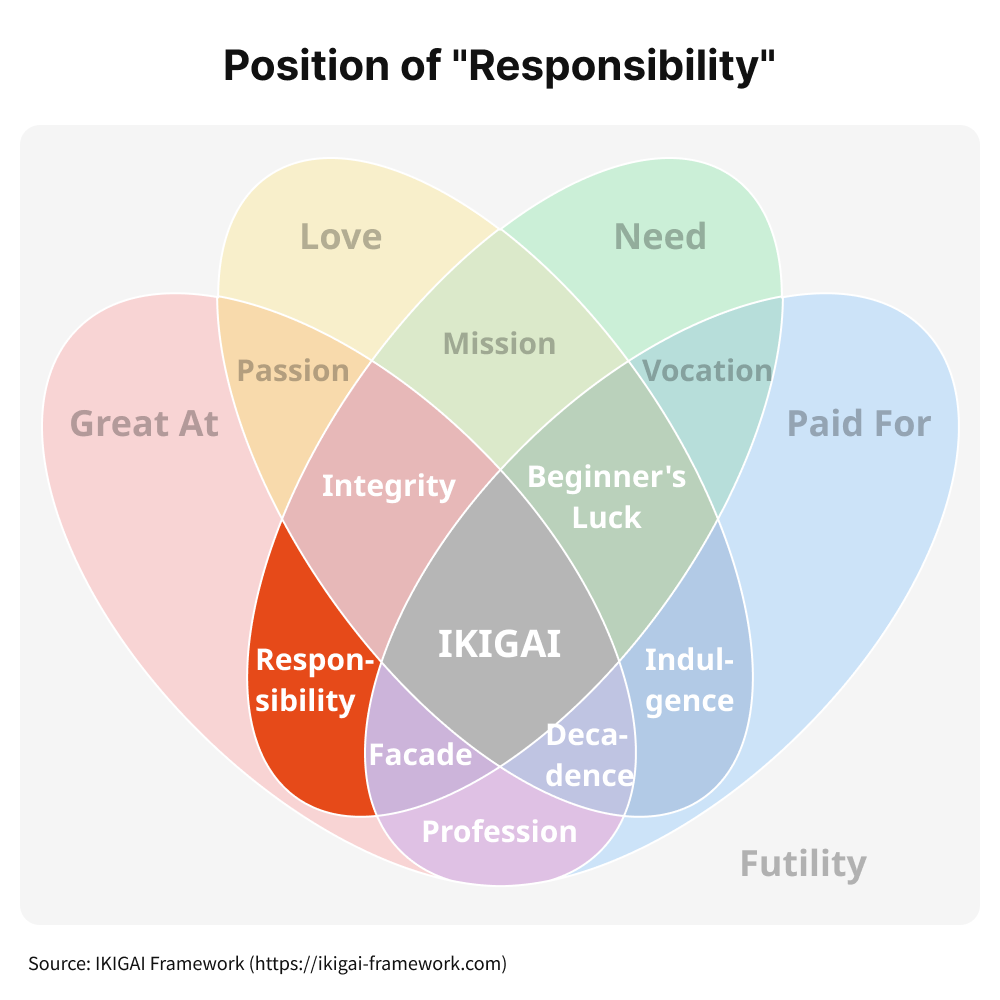
You are "Great At" it and it is "Needed," but you do not "Love" it and cannot get "Paid For" it. You possess high capabilities and are relied upon by those around you, but your personal feelings and financial rewards are left behind. It is a state of self-sacrificing professionalism, sustained solely by an internal sense of duty and obligation—the feeling that "I have to do this."
Position of "Responsibility"
Example 1
Sam has served as the neighborhood association's accountant for many years. He has accounting knowledge and practical skills, always delivering accurate work, making him heavily relied upon by residents who say things wouldn't function without him.
However, he personally dislikes this tedious, low-profile task, and since it is purely a volunteer position, there is absolutely no compensation. Sam continues to bear this burden solely because he fears mistakes will happen and cause trouble if he leaves it to someone else, classifying this activity as a "Responsibility" state.
Example 2
As the eldest daughter, Hana single-handedly manages the care schedules and administrative procedures for relatives facing complex situations. Her administrative and organizational skills are outstanding, and she is heavily relied upon because, without her, her relatives' lives would instantly fall apart.
However, the constant family disputes wear her down mentally, and she has absolutely no love for this role. Since it's a family matter, she naturally receives no compensation. Continuing to bear this heavy burden solely out of an obligation that she has to do it, Hana's activity is classified as a "Responsibility" state.
Advice for those in the "Responsibility" state
"Responsibility" is defined as a state where you possess high capabilities and are relied upon by those around you, but your personal feelings and financial rewards are left behind.
To move closer to "Ikigai," you must fill the missing elements of "Love" and "Paid For." You are an extremely capable and altruistic person, but professionalism built on the self-sacrifice of "I have to do this" will lead to mental and physical exhaustion in the long run. First, it is crucial to let go of that excessive sense of obligation and develop the skills to delegate tasks to others or courageously say no.
On top of that, you should either move your activities to an environment that pays a fair reward (Paid For) for your outstanding professional skills (Great At), or negotiate for monetization in your current environment.
By liberating yourself from an overwhelming sense of responsibility to others and reinvesting your time and energy into projects that truly excite you (Love), your high abilities will finally be elevated into a healthy "Ikigai".