
Diagnosis Result: Great At
Talented but uninspired: A hidden treasure left to gather dust in a drawer.
Explanation
Defined as "What you are GREAT AT." Although you possess talent and skills, you have no place to utilize them, they don't generate income, and you don't particularly enjoy doing it. Rather than a job, it remains a dormant "potential" or a mere "special skill" hidden in a drawer.
Position of "Great At"
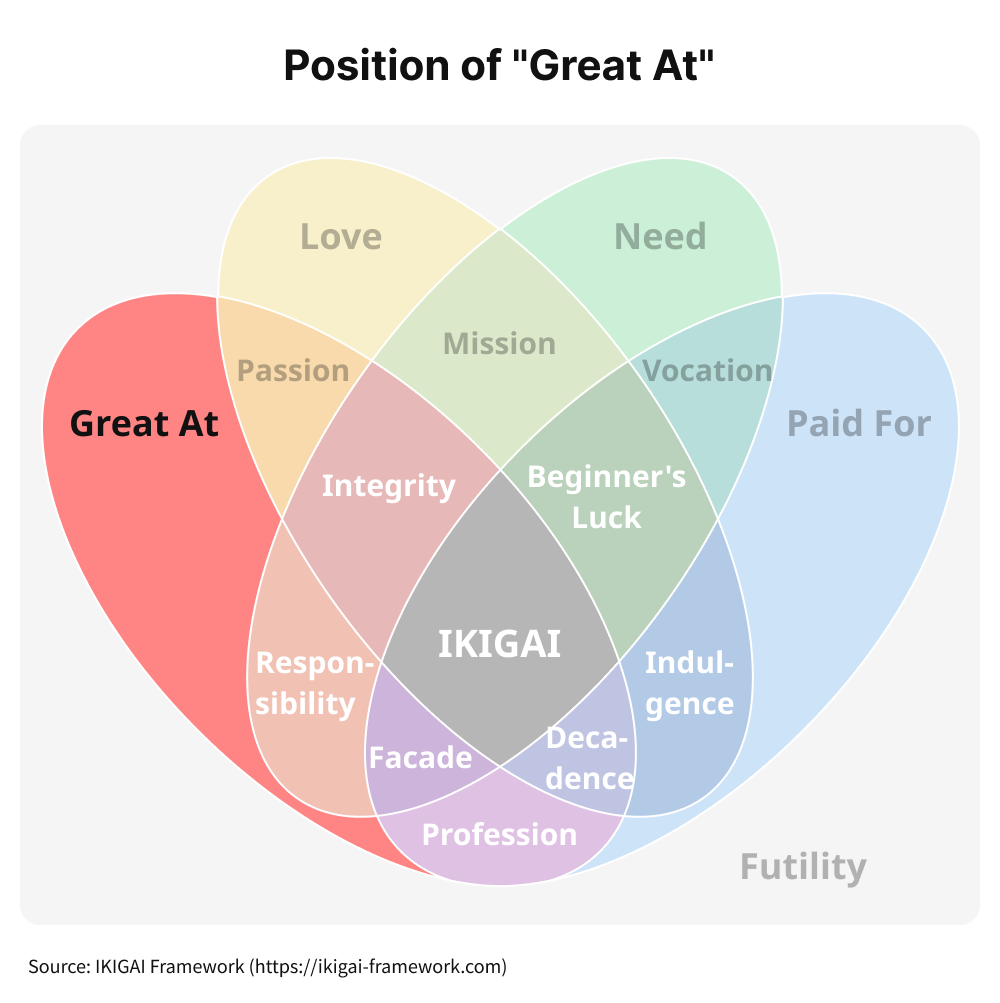
Example 1
Since childhood, Ken has been exceptionally fast at organizing numbers and data, mastering tools like Excel. However, he finds data entry and analysis tedious and unfulfilling, and his current workplace doesn't particularly demand these skills.
While he occasionally helps colleagues by creating simple spreadsheets as a favor, he naturally receives no compensation for it. For Ken, this skill is merely something he finds easier than most. Devoid of passion, fulfillment, and financial return, his situation is classified as a pure "Great At" state.
Example 2
Emma has perfect pitch, an outstanding ability to accurately memorize and reproduce sounds and melodies after hearing them just once.
However, she has little interest in music itself and feels no joy in playing or composing. She is not in an environment where her musical abilities are demanded by others, and naturally, this does not lead to any income. While she might point out accurate pitches during karaoke with friends, it brings in no money, and she feels no sense of fulfillment. For Emma, this ability lacks passion and financial return, making it merely something she can do easily, which classifies it as a pure "Great At" state.
Advice for those in the "Great At" state
"Great At" is defined as a state where you possess talent and skills, but lack a place to utilize them, earn no money from them, and don't particularly enjoy doing them.
To move closer to "Ikigai," you need to fill the currently missing elements: "Love," "Need," and "Paid For." First, try exploring whether you can use your "Great At" skills in a different field or in combination with something else.
For example, if you are good at data processing, try using it to analyze your favorite hobby, opening up a "Great At x Love" area with a small start. Next, test those skills in places where others might need them (like crowdsourcing or volunteering) to practically confirm if there is a "Need." By accumulating experiences where your skills solve others' problems and earn their gratitude, a sense of fulfillment ("Love") will gradually sprout. Once your contribution to others is recognized, a path toward financial reward ("Paid For") will become visible.
The first step is to redefine your skills from a "mere special talent" into a "weapon to make others happy" and have the courage to share them with the outside world.